

Last Updated: October 23, 2026
Quick Summary
High quality graphic tees start with dense, soft fabric in the 160-200 GSM midweight range, ideally ring-spun or combed cotton with a tight knit. Check that the print flexes with the fabric instead of cracking, and that seams are double-stitched with a ribbed collar. The final test is one wash: a good shirt resists shrinkage, twisting, fading and collar sag.
- Squeeze a handful of fabric: good cotton springs back, while thin cheap cotton stays wrinkled and limp.
- Hold the shirt to a lamp; if you can read a hand behind it, the knit is too loose.
- Press your thumb into the print and stretch gently; a good print moves with the shirt rather than cracking.
- Turn the shirt inside out and check for double-stitched shoulder seams, even hems and a ribbed collar.
- Wash cold inside out, skip fabric softener on prints, and air dry or use low tumble.
Table of Contents
- Start With the Fabric: What High Quality Graphic Tees Feel Like
- The Best Fabric for Graphic Tees (and What to Avoid)
- Graphic Tee Print Quality: How to Spot a Print That Lasts
- How to Check T-Shirt Stitching, Seams and Construction
- Fit, Cut and Sizing: Getting the Shoulders Right
- How to Care for Graphic Tees So They Keep Their Shape
- A 7-Step In-Store and At-Home Quality Checklist
- Frequently Asked Questions
Start With the Fabric: What High Quality Graphic Tees Feel Like
High quality graphic tees start with fabric you can judge in seconds. Pick one up, rub it between your fingers, and look at the label.
A good tee feels dense but soft, holds its shape when stretched, and doesn't go see-through under light.
Here's the quick test. Squeeze a handful of fabric and let go. Good cotton springs back. Thin, cheap cotton stays wrinkled and limp.
Fabric Weight and Knit: The Numbers That Matter
Fabric weight is measured in grams per square metre (GSM), and it's the single most useful number on a tee.
Knit matters too. A tighter knit blocks light, resists pilling, and holds a print better. Hold the shirt up to a lamp.
- 120-150 GSM: thin, prone to stretching out
- 160-200 GSM: everyday weight, good drape and structure
- 220+ GSM: heavyweight, boxy streetwear feel, very durable
A common mistake is chasing heavyweight for its own sake. A badly knit 240 GSM shirt can feel stiff and rough.
The Best Fabric for Graphic Tees (and What to Avoid)
The best fabric for graphic tees is a midweight, ring-spun cotton with a tight knit.
Here's how the common options compare:
| Fabric | Feel | Print Performance | Watch Out For |
|---|---|---|---|
| Ring-spun cotton | Soft, smooth | Excellent ink hold | Can shrink if not pre-shrunk |
| Combed cotton | Very smooth | Sharp detail | Costs more |
| Open-end cotton | Rougher | Adequate | Pills faster |
| Cotton-poly blend | Smooth, less breathable | Good, less fade | Can feel slick |
| Tri-blend | Very soft, drapey | Good on light colors | Stretches over time |
Pure cotton wins for breathability. Blends resist shrinking and fading but trap heat and lose that worn-in softness. For everyday wear, cotton or a high-cotton blend is often preferred.
What to avoid: fabric that feels slick or plasticky, shirts with no weight information on the label, and anything that pills the moment you rub it.
Graphic Tee Print Quality: How to Spot a Print That Lasts
Graphic tee print quality comes down to three things: how the ink sits on the fabric, how thick the layer is, and whether it flexes with the shirt. You can test all three by hand, the real skill is spotting failure modes before they happen.
Press your thumb into the print and stretch the fabric gently. A good print moves with the shirt. A bad one cracks at the edges or feels like a stiff sticker sitting on top.
Look at the edges too. Sharp, clean lines mean a controlled print; fuzzy or bleeding edges mean cheap production. Edge quality also signals ink coverage, thin, uneven coverage fades faster because there's less pigment to absorb wear.
How to Evaluate Print Durability Before and After Wear
Print durability is about how the ink layer responds to stretching, abrasion, and washing. Here's what to inspect:
- Print edges: Clean, sharp boundaries indicate a controlled application. Fuzzy or jagged edges suggest low-quality screens or improper curing, and those edges are where cracking starts.
- Ink coverage: Solid areas should look opaque. If the fabric weave shows through, the ink layer is thin and will fade faster.
- Print feel: A good print feels like part of the fabric, not a raised patch. Run your fingers across it. If it feels rubbery or slick, it is likely a heat transfer that will peel.
Different printing methods fail differently. Screen printing pushes thick ink into the fabric, so it lasts and softens with washing but can crack if under-cured. Direct-to-garment (DTG) sprays ink onto the surface, great for fine detail, but it fades faster on dark shirts because the ink sits on top rather than bonding in.
You can usually tell them apart by touch. Screen print sits in the weave. Vinyl sits on top and feels raised and rubbery. DTG often feels soft but can look slightly grainy under magnification.
Prints usually fail at the edges first, which is why edge inspection matters more than the center of the design. Clean edges and integrated ink give a print a better chance of surviving real wear.
How to Check T-Shirt Stitching, Seams and Construction
Knowing how to check t-shirt stitching takes about thirty seconds. Turn the shirt inside out and look at the seams. Clean, tight, even stitches mean the maker cared.
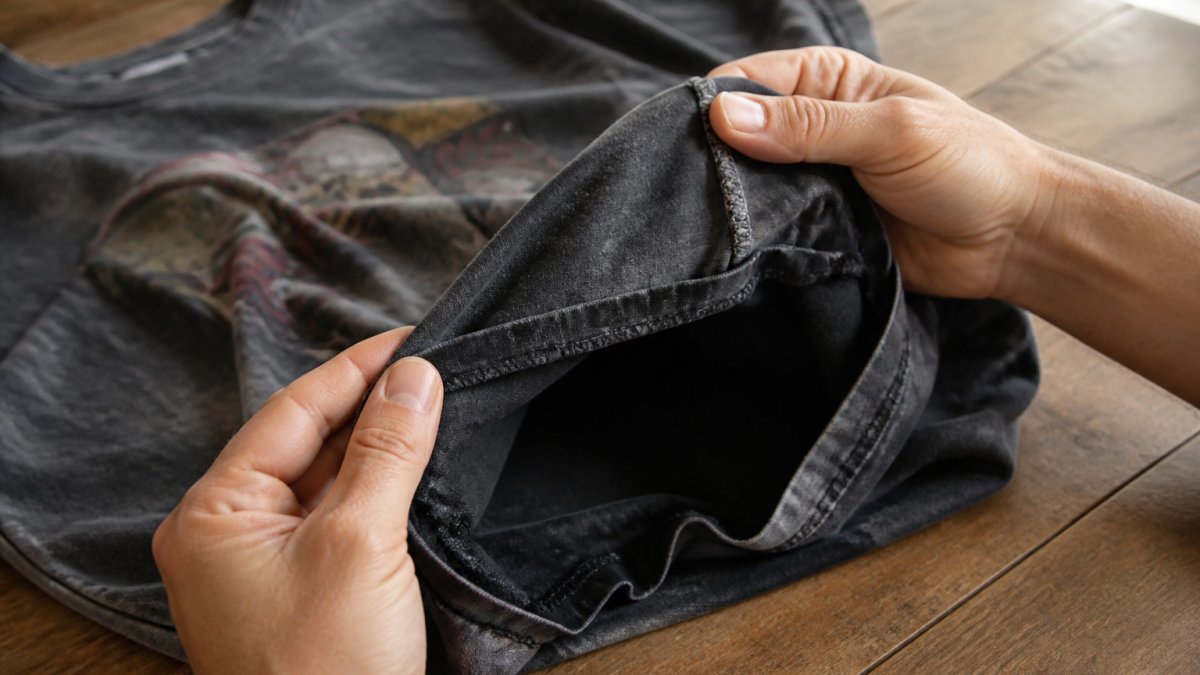
Run these checks:
- Shoulder seams: double-stitched and taped for strength
- Side seams: straight, no puckering or twisting
- Hem: even width, double-folded, no loose threads
The collar is the tell. A flimsy collar stretches out and sags after a few washes. A ribbed collar with a reinforced seam holds its shape and keeps the whole shirt looking sharp.
Fit, Cut and Sizing: Getting the Shoulders Right
Fit is where most people get burned. A tee can be well made and still fit badly. The shoulder seam should sit at the edge of your shoulder, not droop past it or pull inward.
Check these points before you commit:
- Shoulders: seam lands at the shoulder bone
- Chest: fabric sits flat, no pulling across the buttons or print
- Length: hem hits mid-fly to upper hip for a standard cut
Streetwear runs boxy on purpose. That's fine if it's intentional. The problem is a shirt that's baggy in the body but tight in the shoulders, which means the cut is off, not the size.
How to Care for Graphic Tees So They Keep Their Shape
Caring for graphic tees is mostly about heat: heat shrinks cotton, cracks prints, and fades color. Control the heat and the shirt lasts.
Wash cold, inside out, on a gentle cycle. Skip the dryer or use low heat. Hang or lay flat to dry.
- Wash inside out to protect the print
- Cold water, gentle cycle
- No fabric softener on prints (it breaks down ink)
- Air dry or low tumble
A common mistake is washing graphic tees with heavy items like jeans. The abrasion wears the print and pills the fabric.
Quality Checks After Washing: What to Look For
After the first wash, inspect the shirt like you're evaluating it for the first time, this is where real quality separates from a good first impression. Here's a repeatable post-wash checklist:
- Shrinkage: Measure the chest and length before and after the first wash. Most cotton tees shrink 3-5% in length, but a high-quality pre-shrunk shirt should stay within 1-2%. If the shirt shrinks more than that, the fabric was not properly stabilized.
- Twisting: Lay the shirt flat and check if the side seams curve around the body. Twisting happens when the fabric is cut off-grain or the knit is unstable. A well-made tee should hang straight.
- Fading: Compare the print and fabric color to a photo taken before washing. Fading in the first wash suggests poor dye quality or insufficient ink coverage.
- Pilling: Look at the underarm and side areas. Small balls of fiber mean the cotton has short staple fibers or the knit is loose. Combed or ring-spun cotton pills less.
Care instructions tell you what temperature to use, but not whether the shirt was pre-shrunk, the print properly cured, or the knit stable. Those are quality signals you have to verify yourself. A shirt that passes the post-wash check will survive a rotation; one that fails early was never high quality, no matter what the label said.
A 7-Step In-Store and At-Home Quality Checklist
Use this checklist every time you evaluate a graphic tee. It works in a store or on a shirt you already own.
- Step 1: Check the label. Look for GSM weight and cotton type. No info is a red flag.
- Step 2: Squeeze the fabric. It should spring back, not stay wrinkled.
- Step 3: Hold it to the light. You shouldn't see your hand through it.
- Step 4: Stretch the print. It should flex with the fabric, not crack or flake.
That last step is the one most guides skip. A shirt can pass every in-store test and still fail after one wash.
This is also where design and ethics meet garment quality.
Most graphic tees fail for the same reason: the maker cut corners on fabric, stitching, or print, and the shirt gives out within a few washes.
Gilded & Gritty delivers premium, original graphic tees crafted for individuals who value self-expression and confidence in their everyday wardrobe. Moving beyond fast fashion, our collection offers long-lasting quality and effortless streetwear style, ensuring everyday comfort while showcasing your unique identity and passions.
Frequently Asked Questions
How can you tell if a graphic tee is made from quality fabric?
Look at the label first: a mid-weight cotton or cotton-rich blend, roughly 180-220 GSM, holds its shape without feeling stiff. Then feel it. Quality cotton feels smooth and dense, not thin or scratchy, and springs back when you stretch a small section. Hold it to the light: if you can see straight through the knit, it will likely pill and lose shape fast. Check the inside too, since a soft interior surface signals better yarn and finishing.
How do you know if a graphic tee print will last?
Stretch the printed area gently. A quality screen print moves with the fabric and springs back without webbing or flaking. Run your thumb across the design: it should sit slightly on top of the fabric but feel bonded, not like a plastic sheet ready to lift. Look for even ink coverage with crisp edges and no tiny cracks at the corners. Ask how the print is cured and washed. Water-based inks that are properly cured tend to crack and fade far less than cheap heat transfers.
Is 220 GSM cotton good for a graphic tee?
Yes. 220 GSM sits at the heavier end of everyday tees: dense enough to drape well, hold its shape through repeated washing and support a bold print without the fabric going see-through. It can feel warm in peak summer, so it suits streetwear layering and cooler climates better than ultra-light summer basics. Lighter 150-180 GSM tees feel breezier but tend to stretch at the neckline and thin out faster, especially after a few months of regular wear.
What should you check in the seams and fit of a graphic tee?
Turn the shirt inside out and inspect the shoulder, side and hem seams. Quality construction uses tight, even stitching with no loose threads, skipped stitches or puckering, and side seams should run straight rather than twisting after a wash. Double-needle hems and taped neck seams are good signs. For fit, check that the shoulder seam sits at the edge of your shoulder, the collar lies flat without gaping, and the body skims without pulling across the chest.


