

Last Updated: October 23, 2026
Quick Summary
Original graphic tees are worth it if you judge them by cost per wear rather than sticker price. You pay more for artwork made for that shirt and a blank built to last, so you wear it more and replace it less. A budget tee that fades after five wears costs more per wear than a well-made shirt worn weekly for years.
- Original artwork is created by an artist for a specific garment, not licensed or pulled from template libraries.
- Most everyday cotton graphic tees fall between roughly 140 and 200 GSM, with 160-190 GSM the sweet spot.
- Screen printing is the most durable option for bold designs on cotton, while heat transfer is most prone to cracking.
- Wash printed tees inside out in cold water and skip the dryer to protect shape and print.
- Cost per wear divides purchase price by total wears, so estimate wears per year times lifespan in years.
Table of Contents
- Why Original Graphic Tees Cost More (and What You Get for It)
- Original Artwork vs. Mass-Produced Designs
- How to Identify a High-Quality T-Shirt Before You Buy
- Graphic Tee Fabric Weight and GSM: What the Numbers Tell You
- Graphic Tee Print Durability: Which Methods Actually Last
- Fit, Sizing and Comfort: The Details That Decide Daily Wear
- How to Care for Printed T-Shirts So They Keep Their Shape
- Cost Per Wear: The Real Math Behind Original Graphic Tees
- Frequently Asked Questions
Why Original Graphic Tees Cost More (and What You Get for It)
Original graphic tees cost more because you're paying for artwork made for that shirt, not a licensed logo or a template pulled from a stock library. At Gilded & Gritty, that difference is the whole point: every design is drawn as a standalone statement rather than recycled onto a dozen products.
The gap between a budget tee and a premium one is rarely just branding. For context on how fast fashion undercuts quality, that squeeze is where the savings come from.
That's the trade you're making. You pay more up front, and in return you get a shirt that doesn't look like everyone else's and doesn't fall apart by autumn. Whether that's worth it depends on how you wear your clothes, which is what the rest of this guide breaks down.
Original Artwork vs. Mass-Produced Designs
The clearest way to judge originality is to ask who owns the design. Original artwork is created by an artist for a specific garment or collection. Mass-produced designs are licensed, copied, or generated from template libraries and sold across dozens of storefronts at once.
The difference matters more in 2026 than it used to. NPR's 2026 report on graphic tees as a fashion trend noted that graphic tees are having a moment, and that attention has pushed prices in both directions.
Here's what most guides miss: originality isn't a vibe, it's a paper trail. Ask where the design came from, whether the artist was paid, and whether the same print appears on five other sites. If the answers are vague, you're probably looking at a copy.
How to Identify a High-Quality T-Shirt Before You Buy
A high-quality t-shirt shows itself in four checks: fabric weight, stitching, print method, and fit consistency. You can assess all four in under a minute once you know what to look for.
Start with the fabric. Hold the shirt up to light. If you can read a label through it, it's thin.
Then examine the print. Run a fingernail gently across the design. A thick, rubbery layer that sits on top of the fabric is more likely to crack.
Finally, check fit consistency. Compare the size chart against a shirt you already own and like.
For a deeper checklist you can take to the fitting room, see our guide on how to tell high quality graphic tees.
Graphic Tee Fabric Weight and GSM: What the Numbers Tell You
GSM stands for grams per square meter, and it measures fabric weight. For graphic tees, most everyday cotton falls between roughly 140 and 200 GSM, with heavier weights feeling more substantial and holding their shape longer.
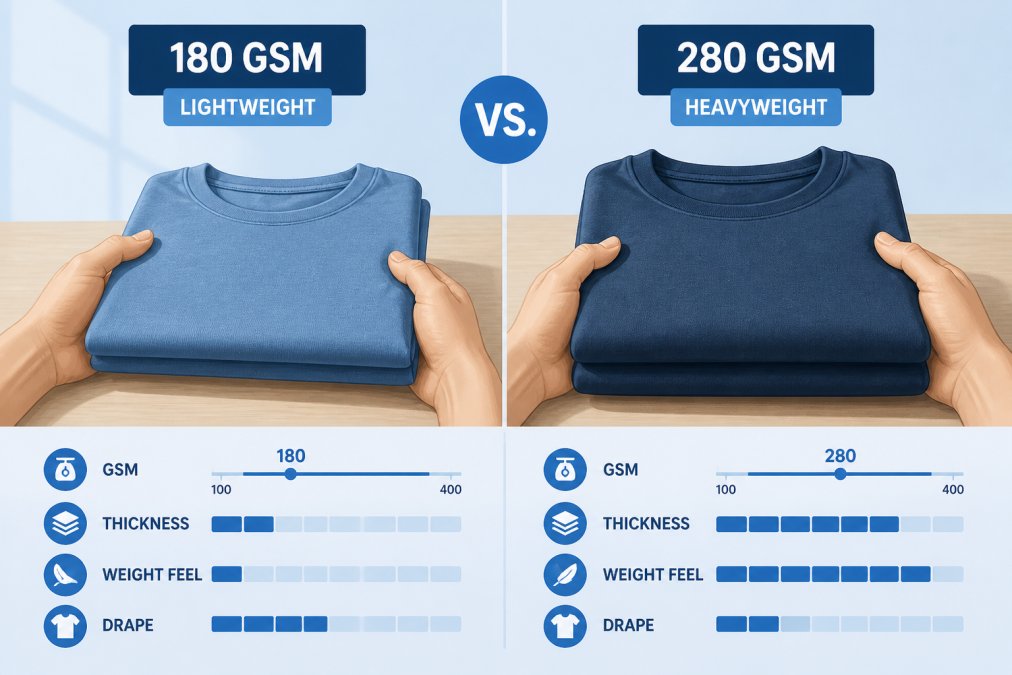
Here's the practical version:
- Under 140 GSM: Light and prone to going sheer. Fine for layering, weak as a standalone tee.
- 140-160 GSM: Standard lightweight cotton. Comfortable, but drapes thin and can stretch out.
- 160-190 GSM: The sweet spot for everyday wear. Substantial without feeling heavy.
- 190+ GSM: Heavyweight. Durable and structured, but slower to dry and warmer in summer.
Weight isn't the whole story, though. How the cotton is spun and combed affects how soft and how durable the fabric feels at any given weight.
That's why a well-made midweight tee can outlast a heavier cheap one. For the fuller explanation of why weight and fiber processing both matter, read our piece on why fabric quality matters for graphic tees.
Here's the practical breakdown of what different fabric weights mean for a graphic tee.
| GSM range | What it means | Note |
|---|---|---|
| Under 140 GSM | Light and prone to going sheer | Fine for layering, weak as a standalone tee |
| 140-160 GSM | Standard lightweight cotton | Comfortable, but drapes thin and can stretch out |
| 160-190 GSM | The sweet spot for everyday wear | Substantial without feeling heavy |
| 190+ GSM | Heavyweight | Durable and structured, but slower to dry and warmer in summer |
Graphic Tee Print Durability: Which Methods Actually Last
Print durability comes down to the method, not the price tag.
Screen printing pushes thick ink through a mesh stencil and cures it with heat.
Direct-to-garment (DTG) works like an inkjet printer for fabric, spraying water-based ink directly into the garment.
Heat transfer prints the design onto a carrier sheet and presses it onto the shirt with a heat press.
Embroidery stitches thread through the fabric rather than printing on it. It's the most durable decoration for logos and simple graphics, and it never cracks or fades in the way ink does.
A common mistake is assuming a thicker print means a tougher print.
Durability also depends on how the garment is finished. A shirt that's been properly cured holds its print far better than one rushed through production.
Texintel's 2025 washing and wear testing of t-shirts found that six of the ten best-performing shirts cost less than £15 and outlasted many pricier ones. That's a useful reminder: price alone doesn't predict durability, but construction and print method do.
Fit, Sizing and Comfort: The Details That Decide Daily Wear
Fit is the reason most graphic tees end up at the back of the drawer. A shirt can be well made and still get worn twice if the shoulders sit wrong or the body is either boxy or clingy.
Three details decide whether a tee becomes a daily staple. First, the shoulder seam should land at the edge of your shoulder, not halfway down your arm. Second, the body should skim rather than hug, with enough room to move without billowing. Third, the neckline should hold its shape, which comes down to the ribbing and how it's attached.
Sizing consistency is the other half of the problem. Unisex sizing is common in streetwear, and it means the same label size can feel different across brands. Always check the size chart against a shirt you already own rather than assuming your usual size carries over.
Comfort follows from the same decisions. Side-seamed construction reduces twisting. A tear-away label removes the itch at the neck. Combed cotton feels smoother against skin from the first wear rather than after ten washes.
How to Care for Printed T-Shirts So They Keep Their Shape
Wash printed t-shirts inside out in cold water, skip the dryer, and they'll keep their shape and print far longer. That's the short version. The longer version is a handful of rules that most people skip.
- Turn the shirt inside out before washing to protect the print from abrasion
- Use cold water; heat is what shrinks cotton and sets cracks in prints
- Skip fabric softener, which coats fibers and can dull the design
- Air dry flat or hang, never tumble dry on high
- Iron inside out on low if needed, never directly on the print
- Fold rather than hang heavy tees, which stretches the shoulders
The single biggest factor is the dryer. Most print failures people blame on the manufacturer happen in the last ten minutes of a hot cycle. Air drying costs you a few hours and saves the shirt.
For the full set of rules we recommend, read how to prevent graphic tees from peeling.
Cost Per Wear: The Real Math Behind Original Graphic Tees
Cost per wear is the price of a garment divided by the number of times you actually wear it.
Start with three inputs: purchase price, expected number of wears, and care costs. Expected wears is the hard part, so use a conservative estimate based on how often you reach for similar shirts in your closet. If you wear a favorite tee roughly once a week for two years, that's about 100 wears. If a budget tee fades or stretches after five wears, that's your realistic lifespan for that shirt.
Run the numbers on your own wardrobe. A budget tee you wear five times before it fades or stretches works out expensive per wear.
Care costs belong in the calculation too. A shirt that requires cold washing and air drying costs you time and a little energy; a shirt you can tumble dry costs less to maintain but may not last as long.
Here's a simple framework you can apply at the checkout:
- Estimate wears per year. Be honest about how often you'll actually reach for it.
- Estimate lifespan in years. Base this on fabric weight, print method, and construction quality.
- Multiply wears per year by lifespan in years to get total wears.
- Divide purchase price by total wears to get cost per wear.
- Add care costs if the garment needs special handling.
This is where the value argument for original graphic tees lands. You're not paying extra for a logo. You're paying for a design you chose, on a blank built to last, which means you wear it more and replace it less. That's the whole case.
If you're ready to put the value argument into practice, browse Be An Original. and see what an original design looks like on a premium blank.

Frequently Asked Questions
Are original graphic tees better quality than mass-produced ones?
Not automatically, but the odds are better. Original designs usually come from smaller print runs where the maker controls fabric and print method. Mass-market tees are built to hit a price point, and buyers report quality dropping. Price alone proves nothing either way. Check fabric weight, stitching and print method before you assume a higher price means better construction.
How can you tell if a graphic tee is high quality?
Start with the label: 100% combed and ring-spun cotton at 4.2 oz (roughly 140-150 GSM) is a solid everyday weight, while 180-220 GSM feels heavier and more structured. Check for side seams rather than tubular construction, look at whether the print sits flat with no cracking at the edges, and feel the fabric for stiffness. A tear-away label and consistent stitching at the hem are small signals that the maker paid attention to the details.
Do graphic tee prints fade or peel after washing?
They can, depending on the print method and how you wash them. Screen-printed designs typically outlast heat-transfer vinyl, which is more prone to peeling at the edges. Washing inside out in cold water and skipping the tumble dryer are the two habits that make the biggest difference. Some mass-market garments fail after only 10 washes, which usually traces back to cheap transfers rather than the fabric itself.
How much should you spend on a quality graphic tee?
Gilded & Gritty's Bella 3001 tees sit at $19.17, using 100% Airlume combed and ring-spun cotton. The better question is cost per wear: a tee worn 60 times costs about $0.53 per wear, while a $10 tee that fades after 8 washes costs $1.25.
The real challenge isn't finding a graphic tee. It's finding one that survives more than a season and still says something about you. Gilded & Gritty builds original graphic tees on premium fabric with designs made for self-expression rather than templates, so the shirt you buy is the shirt you keep wearing. Explore the collection and wear your story with confidence.


