

Table of Contents
- Why Fabric Quality Matters for Graphic Tees
- The Best Fabric for Graphic Tees: What Holds Ink and Lasts
- How to Prevent Graphic Tee Prints from Cracking
- How to Wash Graphic Tees Without Ruining the Print
- How to Identify the Cause of Peeling and Cracking
- Safe Repair Methods for Prints That Have Already Cracked
- Everyday Wear, Storage, and Choosing a Tee That Lasts
- Frequently Asked Questions
Last Updated: October 16, 2026
Why Fabric Quality Matters for Graphic Tees
Fabric quality is the single biggest factor in whether a graphic tee survives fifty washes or falls apart after five.

Cheap blanks use short cotton fibers that pill, warp, and shed. Good fabric holds its shape, resists friction, and gives the ink something to grip.
Below, we break down how to pick a durable graphic tee, how to stop prints from cracking, and how to wash the ones you already own.
The Best Fabric for Graphic Tees: What Holds Ink and Lasts
The best fabric for graphic tees is a tightly knit, combed, and ring-spun cotton in a mid-weight range. Combed cotton has shorter fibers removed for a smoother yarn; ring-spun yarn is twisted tighter, making it softer and stronger.
Loose, open knits are the problem. Ink sits on the surface instead of bonding into the weave, so it flakes off fast.
Look for these markers on the label:
- 100% combed and ring-spun cotton for the smoothest print surface
- A mid-weight fabric that feels substantial without being stiff
- Side-seamed construction so the shirt doesn't twist in the wash
Why Print Method and Fabric Have to Match
Every print method bonds differently, and the fabric has to suit it.
Here's what most guides miss: a print can fail because the fabric was wrong, not because the print was bad.
This is why we deliver premium, original graphic tees crafted for individuals who value self-expression and confidence in their everyday wardrobe. The combination matters more than either part alone.
How to Prevent Graphic Tee Prints from Cracking
Preventing cracks comes down to three things: reduce heat, reduce friction, and reduce harsh chemicals. Most cracking happens in the wash and dry cycle, not on the hanger.
Follow these rules and your prints will hold up far longer:
- Wash in cold water. Hot water softens and stresses the ink layer.
- Turn the shirt inside out before it goes in the machine.
- Use a gentle or delicate cycle to cut down on agitation.
- Pick a mild liquid detergent over harsh powders.
- Skip bleach entirely. It breaks down both dye and ink.
- Dry on low heat or air-dry when you can.
- Limit dryer time and pull the shirt out slightly damp.
One more habit that pays off: wash printed shirts with like colors and similar fabrics. Zippers and rough denim rub against prints and wear them down.
How to Wash Graphic Tees Without Ruining the Print
Washing graphic tees the right way means cold water, an inside-out shirt, a gentle cycle, and mild liquid detergent.
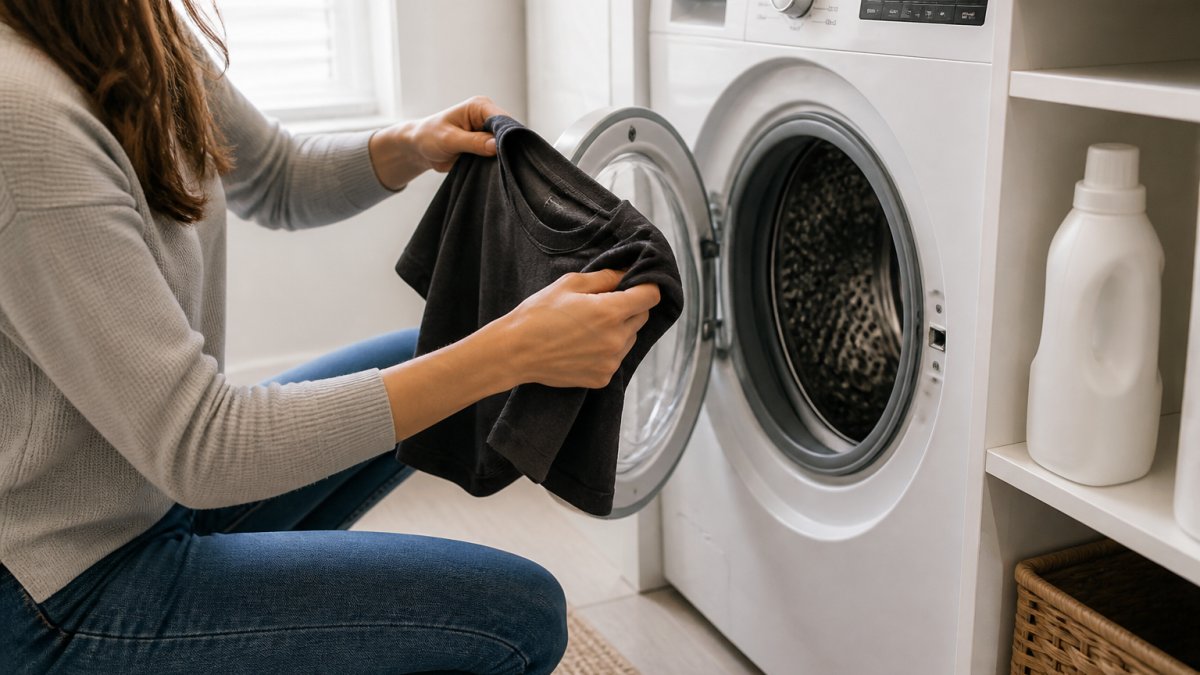
Here is the full routine, start to finish:
- Turn the shirt inside out and close any buttons or zips.
- Set the machine to cold water and a gentle or delicate cycle.
- Add a mild liquid detergent, not powder.
- Skip bleach and fabric softener.
- Wash with like colors and similar weights.
- Tumble dry on low, or hang the shirt to air-dry.
- Remove it while still slightly damp to avoid heat stress.
Air-drying is safest for any print you care about. If you must use the dryer, keep the heat low and the time short.
Read the Care Label First, Then Adjust
The care label is written for the garment, not the print. When the two conflict, protect the print:
- 100% cotton, machine wash warm, tumble dry medium. The label assumes an undecorated shirt. For a print, drop to cold wash and low or air dry. Cotton can take heat; cured plastisol ink and vinyl cannot.
- Cotton/polyester blends, machine wash cold, tumble dry low. Follow the label. Blends dry faster and shrink less, so low heat is usually enough. High heat can still dull DTG ink.
- Tri-blends (cotton/poly/rayon), machine wash cold, lay flat to dry. Rayon weakens when wet, so hanging a heavy wet tri-blend can stretch the shoulders and distort the print. Lay flat instead.
When in doubt, wash colder and dry cooler than the label says, trading a little cleaning power for a lot more print life.
Washing by Print Type: Screen Print, Vinyl, and DTG
Each print type has its own weak spot, so the care routine shifts a little based on how the ink or film bonds to the fabric.
| Print Type | How It Bonds | Main Risk | Wash Setting | Drying |
|---|---|---|---|---|
| Screen print (plastisol) | Ink is pushed through a mesh and heat-cured into the fabric | Cracking from heat and friction | Cold, gentle, inside out | Low heat or air-dry |
| Screen print (water-based) | Ink soaks into the fibers and cures thin | Fading and dulling | Cold, gentle, inside out | Air-dry preferred |
| Heat-transfer vinyl | A plastic film is pressed onto the surface | Peeling at the edges | Cold, gentle, inside out | Air-dry preferred |
| Direct-to-garment (DTG) | Water-based ink is sprayed and pre-treated into the weave | Fading, dulling, and wash-out on dark shirts | Cold, gentle, inside out | Low heat or air-dry |
Vinyl is the most fragile: it sits on the surface, so any heat or friction lifts the edges. Plastisol screen print is toughest when cured well. Water-based screen print and DTG feel softer but fade faster, so keep them out of the dryer.
First-Wash Precautions for a Brand-New Print
A new print is not always fully settled the day it ships. Heat-transfer vinyl keeps bonding for roughly 24 to 72 hours after pressing, and DTG ink continues to cure over the first day or two. Two habits protect a fresh design:
Find Me Under The Palms Graphic Tee →
- Wait at least 24 hours after delivery before the first wash. If the shirt arrived folded tight in a poly bag, let it breathe and relax first.
- Wash the first load alone or with soft items only. No denim, no zippers, no towels with rough hems. The first wash is when a weak bond is most likely to fail.
If a print lifts on the very first wash, that is usually a production issue, not a care issue.
How to Identify the Cause of Peeling and Cracking
Peeling and cracking almost always trace back to one of five causes: heat, friction, harsh chemicals, a bad fabric-to-print match, or a print method never suited to the design. Figuring out which one hit your shirt tells you how to prevent it next time, and whether it is worth repairing.
Start by looking at where the damage is and how it looks. The pattern usually names the cause.
A Diagnostic Guide by Damage Pattern
- Fine cracks across the whole design, like dried mud. Heat damage. A hot dryer, a hot iron, or repeated high-heat washes shrank the ink layer faster than the fabric underneath. Plastisol screen prints crack this way; vinyl usually does not.
- Peeling at the edges only, lifting like tape. Adhesion failure. Either the vinyl was under-pressed at the factory, the fabric was too loose a knit for the film to grip, or friction from washing with rough items lifted the edge.
- Faded and dull overall, no cracks. Chemical or UV damage. Bleach, harsh detergent, or long sun exposure broke down the dye and ink together. This is common with DTG and water-based screen prints.
Match the Cause to the Print Method
The same symptom points to different causes depending on how the shirt was printed.
- Screen print cracking is almost always heat or age. Plastisol is durable; if it cracked early, a hot dryer is the usual suspect.
- Vinyl peeling is almost always adhesion or friction. Vinyl does not crack the way screen print does, it lifts. If you see cracking in vinyl, the film itself has aged out.
- DTG fading is almost always wash chemistry or dryer heat. DTG ink sits in the fibers, so bleach, fabric softener, and high heat strip it faster than they affect screen print.
Friction is the sneaky one. A print rubbing against the dryer drum or a zipper in the same load wears down over dozens of cycles, you won't see it after one wash, but after thirty.
Once you know the cause, you can stop it from happening again, and decide whether the shirt is a candidate for repair or replacement.
Safe Repair Methods for Prints That Have Already Cracked
You can repair minor cracking and lifting at home. The goal is to re-bond the ink or vinyl without scorching the fabric.
Try these methods, from gentlest to most involved:
- Re-press with heat. Turn the shirt inside out and press with a warm iron for a few seconds, using a protective cloth over the print.
- Use parchment paper. Place it over the print and press lightly to re-adhere lifting vinyl edges.
- Spot-fix with fabric glue. For small lifted corners, a tiny dot of flexible fabric glue can hold the edge down.
- Layer a new patch. For large damaged areas, a fresh iron-on patch can cover the crack.
A common mistake is pressing too hard or too hot. That makes it worse. Use low heat, short bursts, and always keep a barrier between the iron and the print.
If the design is cracked beyond repair, that is a sign the fabric and print were never a good match.
Everyday Wear, Storage, and Choosing a Tee That Lasts
How you wear and store a tee matters as much as how you wash it. Small daily habits add up over the life of the shirt.
For everyday wear:
- Avoid heavy backpacks or straps that rub against the print.
- Don't spray perfume or deodorant directly on the design.
- Rotate your tees so no single shirt takes all the wear.
For storage:
- Fold shirts instead of hanging them to avoid shoulder stretch.
- Keep them out of direct sunlight, which fades both fabric and ink.
- Store in a cool, dry place away from damp.
How to choose a durable graphic tee: check the fabric content first, then the print method, then the construction. A combed, ring-spun cotton blank with side seams and a well-cured print will outlast a cheap alternative by years, the difference between fast fashion and a shirt you keep.
When you buy from Gilded & Gritty, you get original designs printed on premium fabric built to last. Our Kawaii Ramen Cat Graphic T-Shirt pairs bold artwork with a soft, durable cotton blank, and our Find Me Under The Palms Graphic Tee shows how a design holds its color wash after wash.

Frequently Asked Questions
How does fabric quality affect the durability of a graphic tee?
Fabric quality determines how well a shirt holds its shape and how well the print bonds to it. A tightly knit, ring-spun cotton surface gives ink or vinyl a smoother base, so the print resists cracking and peeling through repeated washing. Lower-quality fabric pills, stretches, and loses shape faster, which pulls the print apart along with it. The fabric is the foundation, and if it fails, the graphic goes with it.
How can you tell if a graphic tee is made from quality fabric?
Check the label for specifics like combed and ring-spun cotton, which signals longer fibers and a smoother surface. Feel the fabric: it should be soft but substantial, not thin or stiff. Look at the seams, side-seamed construction holds shape better than tubular cuts. Also check the print itself. A print that feels like a thick plastic layer sitting on top of the fabric is more likely to crack than one that sits closer to the surface.
Which fabric is best for graphic tees?
Combed and ring-spun cotton is the standard for quality graphic tees. The combing removes short fibers, and ring-spinning twists the remaining ones tighter, producing a smoother, stronger yarn that takes ink well and feels soft against skin. Blends with a small amount of polyester can add durability, but high-polyester fabric tends to feel slick and can affect how vinyl and screen prints adhere. For everyday comfort and print longevity, a well-made cotton tee is hard to beat.
How do you keep graphic tees from cracking?
Wash them in cold water on a gentle or delicate cycle, turn them inside out first, and use a mild liquid detergent instead of powder. Skip bleach entirely. When drying, use low heat or hang them to air-dry, and limit time in the dryer as much as possible. Heat is the main enemy of print adhesion, so anything you do to reduce heat exposure, in the wash or the dryer, extends the life of the graphic.
Cheap tees crack, fade, and peel because the fabric was never built to hold a print. You deserve better than a shirt that gives up after a month. At Gilded & Gritty, every tee starts with premium fabric, original designs, and long-lasting quality you can feel. Browse the collection and wear your story with confidence. [VIEW ALL]


