
Table of Contents
- Why Original Streetwear Designs Are Harder to Spot Than Ever
- Start With the Print: Quality Signals That Separate Original From Generic
- How to Spot Dropshipped Clothing Brands Before You Buy
- How to Check if a Clothing Design Is Copied
- Streetwear Design Inspiration vs Copying: Where the Line Sits
- Streetwear Brand Design Identity: What a Real One Looks Like
- A Practical Originality-Check Workflow You Can Run in 10 Minutes
- Frequently Asked Questions
Last Updated: October 21, 2026
Why Original Streetwear Designs Are Harder to Spot Than Ever
Spotting original streetwear designs in 2026 takes more than a gut feeling, it takes a close look at the print, the fabric, and the story behind the brand.
Fast fashion and dropshipping have flooded the market with copycat graphics, the same skull, flame font, or bootleg anime print on a dozen storefronts.
To tell a real original from a reworked template, check the details: print quality, construction, image searches, and a simple 10-minute workflow.
Start With the Print: Quality Signals That Separate Original From Generic
The print is your fastest tell. A genuine original comes from a brand that invested in the artwork and print method; a generic design often uses a cheap transfer that cracks or peels within a few washes.
Print Method, Ink Depth, and Edge Definition
Look closely at the graphic. Here's what separates real from rushed:
- Ink depth: Run a finger across the print. If it feels like a thick plastic sheet, it's likely a heat transfer.
- Edge definition: Crisp, clean edges with no halo or blur. Fuzzy edges usually mean a low-resolution file got blown up.
- Color layering: Bold graphics with multiple colors often use separate screens. Sloppy registration (colors that don't line up) is a red flag.
Fabric, Seams, and Construction Checks
Turn the shirt inside out, a brand that cares about original design usually cares about the garment too.
- Side seams: A well-made tee has side seams that follow the body. Tubular construction (no side seams) is cheaper and twists after washing.
- Stitching: Even, tight stitching at the collar and hems. Loose threads and skipped stitches signal low effort.
- Fabric weight: Heavier cotton holds a print better and lasts longer. Thin, see-through fabric rarely carries a premium graphic well.
At Gilded & Gritty, every tee is built on 100% Airlume combed and ring-spun cotton with side seams and a retail fit, part of why the prints hold up.
How to Spot Dropshipped Clothing Brands Before You Buy
Dropshipped clothing brands list a product, then ship it straight from a third-party supplier, the seller often never touches the garment, so design, fit, and quality can vary wildly.
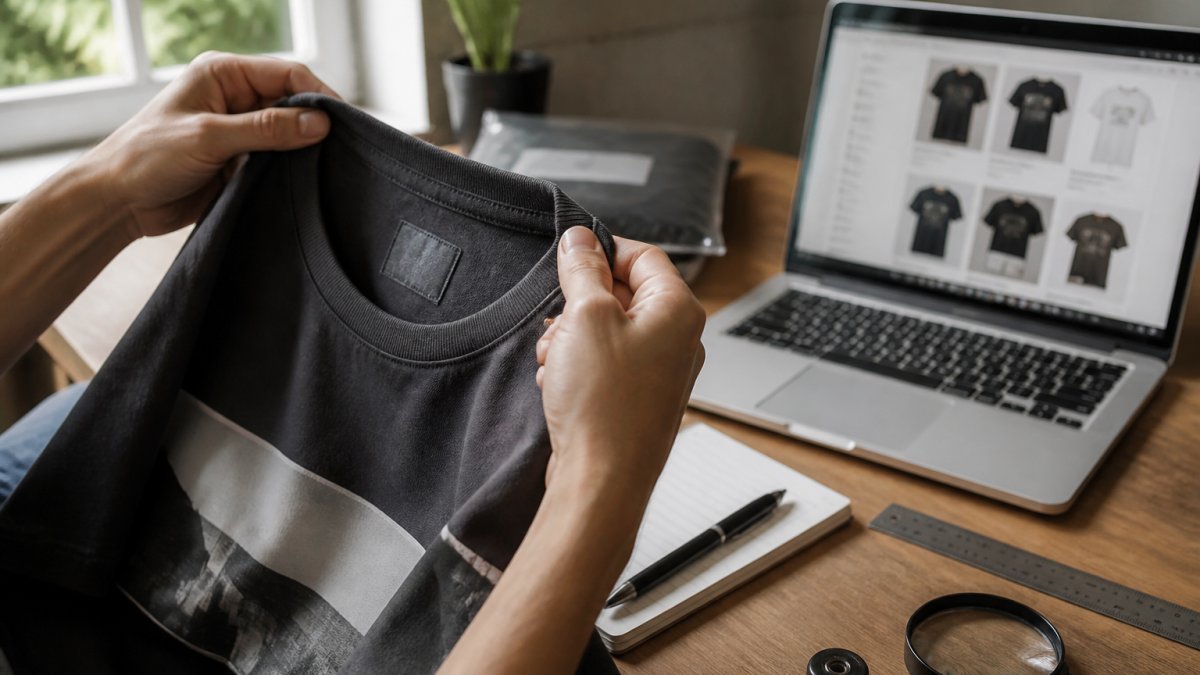
Spotting these stores takes a few quick checks:
- Shipping times: Long, vague delivery windows (three to six weeks) often mean overseas dropshipping.
- Product photos: The same stock photo appears across many stores. Reverse-search the image to confirm.
- Catalog spread: A store selling tees, phone cases, and kitchen gadgets in one place rarely designs its own apparel.
A brand that designs its own graphics talks about the artwork, shows process shots, and stands behind the fit. If you can't find any of that, slow down.
How to Check if a Clothing Design Is Copied
Checking whether a clothing design is copied starts with a reverse image search, then a quick legal and creative review: does the exact graphic exist elsewhere, and was the idea lifted from another artist?
Reverse Image Search and Visual Research Tools
Reverse image search is the fastest way to trace a design. Save the product image, then run it through:
- Google Lens for a broad web match
- TinEye for exact and edited copies
- Pinterest visual search for mood-board and streetwear matches
If the same graphic shows up on five stores with different logos, that's a red flag. If it traces back to one artist with a visible portfolio, you've likely found the source.
Copyright, Trademark, and Design-Right Basics
Copyright protects the original artwork itself, like a drawing or illustration. Trademark protects brand names, logos, and slogans. Design rights can protect the look of a product. The U.S. Copyright Office guide to visual arts explains what counts as protected artwork, and the USPTO trademark basics covers logos and brand names.
What this means for you as a buyer:
- A copied character or logo can be a legal problem, not just a style one.
- A design that remixes a famous logo without permission is usually imitation, not inspiration.
- Original artwork with a clear creator and a paper trail is the safest bet.
Streetwear Design Inspiration vs Copying: Where the Line Sits
Inspiration pulls from culture and makes something new; copying lifts the exact image, layout, or logo and calls it your own. The line sits in transformation, how much of the original idea got reworked into something with its own voice. Here's a rubric to apply before you buy or produce any design.
A Four-Criteria Originality Rubric
Score each design 1 (weak) to 5 (strong) on these four criteria. A design scoring 3 or higher on at least three criteria is likely original enough; anything scoring 2 or lower on two or more deserves a second look.
- Distinctiveness: Does the design have a visual element you can't find elsewhere, a unique composition, custom illustration style, or unexpected color pairing? A generic skull-and-flames graphic scores low; a skull reimagined as a circuit board with a specific color story scores higher.
- Transformation: How far is the design from its source reference? Minor changes (same silhouette, font, layout) mean low transformation. A recontextualized reference, say, a vintage band tee layout rebuilt with original hand-drawn typography and a new message, means high transformation.
- Cultural context: Does the design engage with a subculture in a way that feels informed rather than extracted? A brand referencing skate culture should show involvement (team riders, event sponsorship, community feedback). Slapping a skate graphic on a tee with no connection to the scene is copying the aesthetic without the context.
Real-World Examples of the Line
- Inspiration: A designer visits a Japanese woodblock print exhibition, sketches the wave patterns, and then redraws them as a repeating motif on a hoodie with a completely new color palette and scale. The reference is clear, but the execution is new.
- Copying: A brand takes a Supreme box logo, changes the font slightly, and prints it on a tee. The layout, color, and proportion are identical, only the word changes. That is a straight flip, not inspiration.
- Remixing (legitimate): A designer combines public-domain Victorian engravings with original graffiti lettering to create a hybrid graphic. Because the source art is public domain and the combination is novel, this is a valid remix.
How to Document Your References
If you are a designer, keep a dated reference log for every project: the source, what you took from it, and how you transformed it. This log helps you prove originality if challenged and forces honesty about how much you borrowed. Buyers should ask brands if they keep a similar process, brands that document references are more likely working from inspiration than copying.
A straight flip of an existing piece is copying; reworking the reference into a distinct visual language is inspiration. The rubric lets you tell the difference without relying on gut feeling.
Streetwear Brand Design Identity: What a Real One Looks Like
A real streetwear brand design identity is consistent, recognizable, and rooted in a clear point of view, the same typography, color instincts, and attitude across every drop. It's also a tool for judging originality: a brand with a strong identity is more likely designing its own work, because copying rarely produces a coherent visual language across multiple pieces.
The Five Signals of a Real Design Identity (and How to Verify Them)
- Consistent typography: A brand with identity uses a signature type style, not a random template font. Verification: compare three products, do they share a font family or deliberate typographic system? Different fonts on each product suggest template assembly.
- Recurring visual language: Shared motifs, line weights, or color palettes tie designs together. Verification: collect five products and look for repeated elements, a specific shade of red, a recurring line style, a consistent illustration technique. If nothing repeats, there is no identity.
- A brand narrative: A story about why the brand exists and who it speaks to. Verification: read the About page for specific influences, a founding story, or a design philosophy, or generic filler like "we are passionate about streetwear." Brands that design their own work talk about the process.
How Identity Connects to Originality
A brand with a strong identity is harder to copy because the identity lives in the relationships between designs, not just a single graphic. Consistent illustration style, color palette, and typography across drops is evidence of an internal design process; jumping from trend to trend, anime print one week, bootleg logo the next, signals template-flipping or dropshipping.
A Quick Identity Audit You Can Run in 5 Minutes
- Open the brand's product page and screenshot five different designs.
- Compare them side by side. Do they share at least two visual elements (color, line style, typography, motif)?
- Read the About page and look for specific references (artists, subcultures, cities, eras).
- Check social media for customer photos and community engagement.
- Look for process content, sketches, studio shots, design notes. Brands that design their own work often share this; dropshippers rarely do.
If the brand passes at least three of these five checks, it likely has a real design identity. If it fails three or more, treat the originality of its designs with skepticism.
Gilded & Gritty builds each design as a bold, expressive statement, free from templates. That's the goal of a real design identity: clothing that speaks before you do.
A Practical Originality-Check Workflow You Can Run in 10 Minutes
Here's the 10-minute workflow we'd run before buying any graphic tee, it saves you from a closet full of peeling copies.
| Step | What You Do | Time | What It Tells You |
|---|---|---|---|
| 1. Reverse image search | Run the product photo through Google Lens and TinEye | 2 min | Whether the exact graphic exists on other stores |
| 2. Check the artist | Search the design name plus "artist" or "original" | 2 min | Whether a real creator and portfolio exist |
| 3. Inspect the print | Ask for or zoom into close-ups of ink and edges | 2 min | Print method and quality signals |
| 4. Review construction | Check side seams, labels, and fabric weight | 2 min | Whether the garment is built to last |
| 5. Read the brand story | Look for an about page, process shots, and community | 2 min | Whether the brand designs its own work |
Run the steps in order. If a design fails at step one or two, stop there; if it passes, the print and construction checks tell you whether the quality matches the originality.
For a deeper legal reference on what counts as infringement, the World Intellectual Property Organization overview of copyright is a solid starting point.
The market is full of copycats, and telling a real original from a reworked template takes a trained eye. Ready to wear your story with confidence? Browse the full collection and find your next statement piece.
Frequently Asked Questions
How can you tell if a streetwear design is original?
Look for design decisions that would be expensive or awkward to copy: custom typography rather than common fonts, artwork that matches the garment's cut, and a print that holds fine detail at the edges. Run a reverse image search on the graphic and check whether the same artwork appears on unrelated stores. Original streetwear designs usually come with a visible story, a dated collection, and a designer you can trace. If none of that exists, treat the design as generic until proven otherwise.
Does a high-quality print mean a streetwear design is original?
No. Print quality and design originality are separate questions. A dropshipped brand can print a stolen graphic on a decent blank and it will look sharp. Check both: the print should have clean edges, even ink depth, and no cracking along folds, and the artwork itself should survive a reverse image search without matching a dozen other stores. Good production on copied art is still copied art.
How do I spot dropshipped clothing brands before ordering?
Check three things. First, the shipping and returns page: vague timelines and no physical address are warning signs. Second, the product photos: reused supplier images across multiple stores usually mean no original photography. Third, the catalog: dozens of unrelated niches (anime, fishing, crypto, dogs) in one store points to a supplier feed rather than a designed collection. A brand with real streetwear brand design identity keeps a narrow, consistent visual language across everything it sells.
What is the difference between streetwear design inspiration and copying?
Inspiration takes a reference and changes the decisions: new composition, new type treatment, new color logic, a different cultural starting point. Copying reproduces the recognizable part, the exact silhouette, the same slogan, the same layout, and adds nothing. A useful test is whether someone familiar with the original would name it instantly. If they would, you are looking at a copy, not an homage. Documenting your references and process is what keeps a design on the right side of that line.


